O3 PRISM

Enterprise-Grade Data Management That Runs Itself

O3 Prism, the automated data management engine built into every O3 deployment, turns project data from any source into validated, construction-ready information, so capital project teams always build from current, accurate data.
TRUSTED BY
Shell-Logo
Worley_2023_Dark
Linde-Logo
Dematic_Logo_RGB-1
melius-logo
logo-sierra-gorda
logo-turner-industries-e1616336899597
Target logo
Wood-logo-GREY-70mm
logo-aecon-red
Tecnicas_Reunidas_logo
McDermott_International_logo
Shell-Logo
Worley_2023_Dark
Linde-Logo
Dematic_Logo_RGB-1
melius-logo
logo-sierra-gorda
logo-turner-industries-e1616336899597
Target logo
Wood-logo-GREY-70mm
logo-aecon-red
Tecnicas_Reunidas_logo
McDermott_International_logo
Shell-Logo
Worley_2023_Dark
Linde-Logo
Dematic_Logo_RGB-1
melius-logo
logo-sierra-gorda
logo-turner-industries-e1616336899597
Target logo
Wood-logo-GREY-70mm
logo-aecon-red
Tecnicas_Reunidas_logo
McDermott_International_logo
Shell-Logo
Worley_2023_Dark
Linde-Logo
Dematic_Logo_RGB-1
melius-logo
logo-sierra-gorda
logo-turner-industries-e1616336899597
Target logo
Wood-logo-GREY-70mm
logo-aecon-red
Tecnicas_Reunidas_logo
McDermott_International_logo
The Data Problem

Project Data Rarely Arrives  Ready to Build From 

Capital projects run on data that comes in late, in every format and from dozens of sources. Design models are built for engineering rather than for packaging, sequencing or progress, so most teams close the gap with people: analysts cleaning spreadsheets, scripts written for each new data set and models sent back to engineering for missing attributes.

That manual work has a cost beyond the hours. When every refresh takes effort, teams update less often and plan from old revisions, and the missing attribute or conflicting tag that nobody caught shows up in the field instead of before import.


How O3 Prism Works

Point at Your Data, and O3 Prism Does the Rest

Your team connects O3 Prism to the place project data already lives, whether that's SharePoint, Autodesk Construction Cloud or a cloud folder, and it pulls new data on a schedule. From there, O3 Prism handles the steps that used to need an analyst: It detects what each file holds, sets the scope the data will serve, and checks everything against ISO, CII definitions or your own standard.

O3 Prism then generates the data deliverables for your team to review and finalize. Once the data is in, it checks every component and work package against what its scope requires, and every gap becomes a constraint or task with an owner. Your people step in only where judgment matters: reviewing the mapping and owning the fixes.

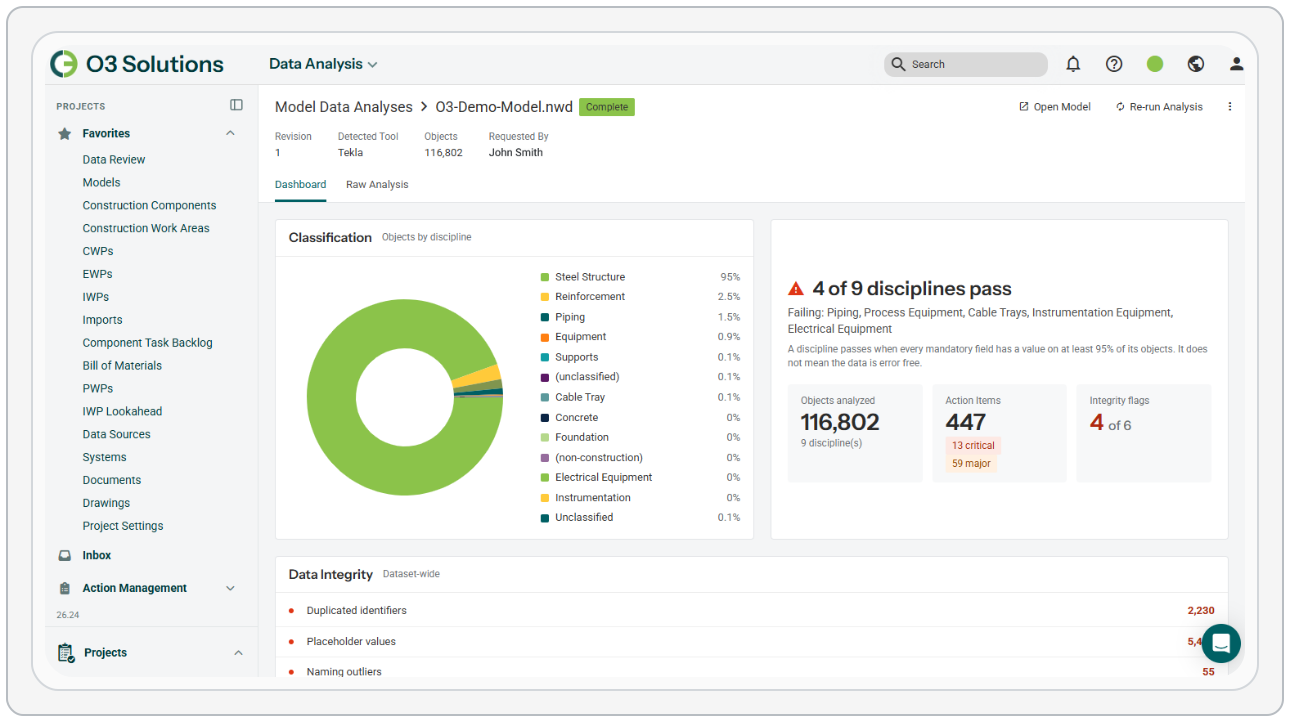
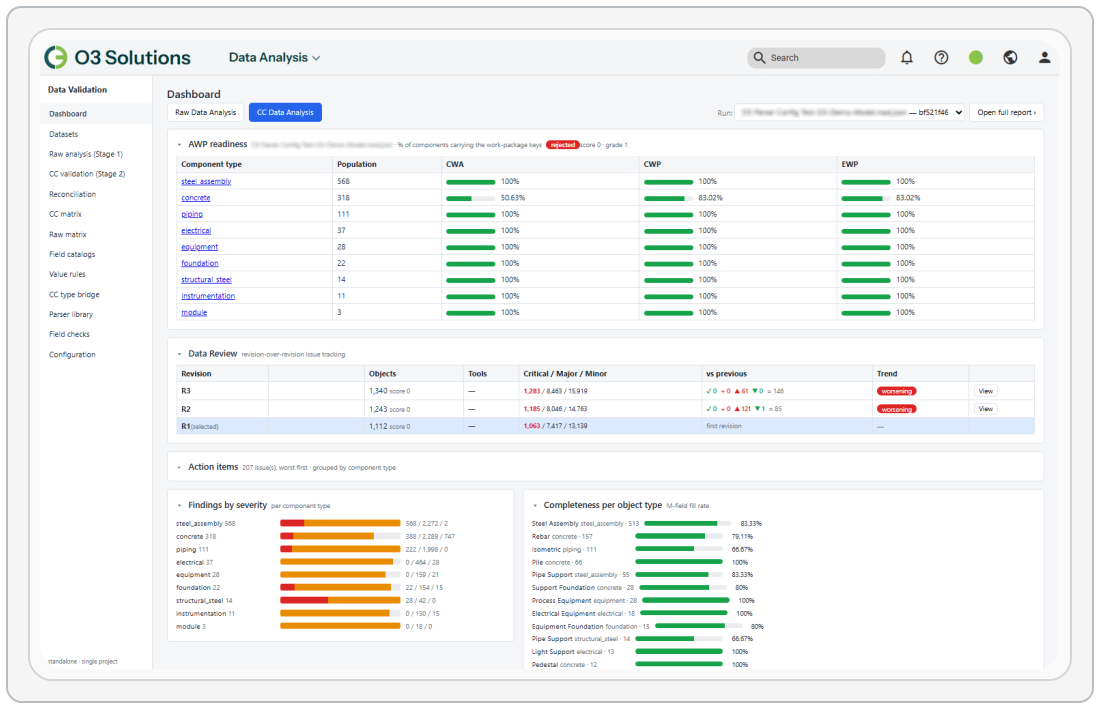
o3-prism-hero-dashboard
What O3 Prism Does

Built to Keep Construction Data  Current, Complete  and Under Your Control

Built-In Intelligence

Runs Itself

O3 recognizes, parses, maps and validates project data with little manual effort. Validation rules are reused across projects, so nobody writes a new script for each data set.

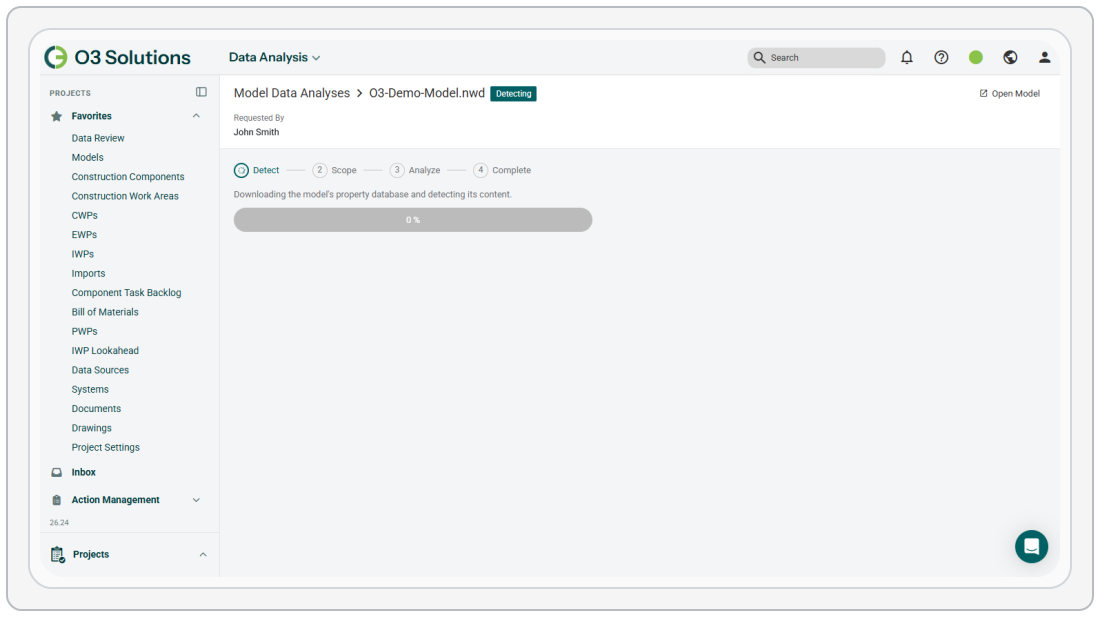
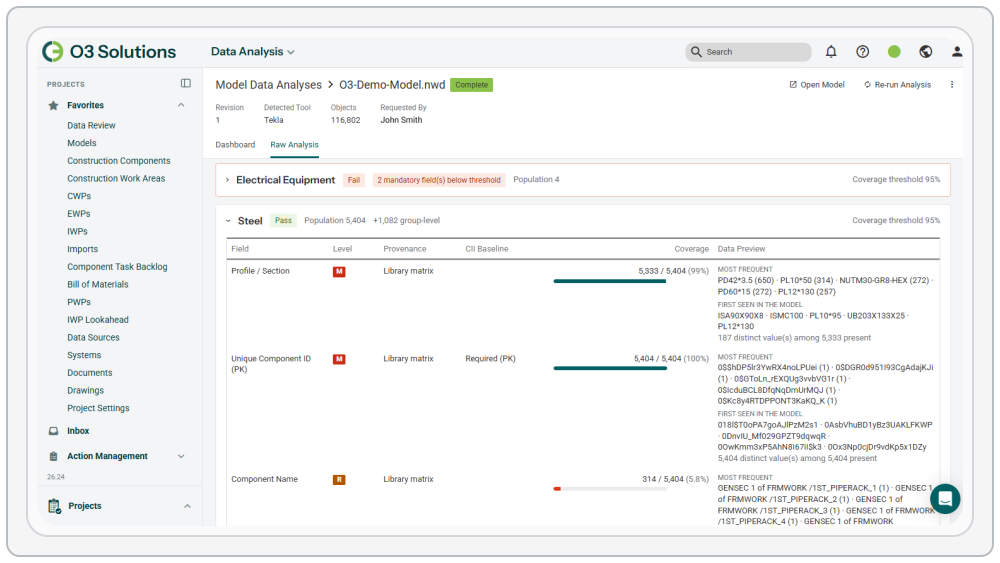
O3 Prism detecting the content of a 3D model
Integrations

Any Source, Any Format

Data comes in the way your team already has it. O3 reads native 3D model formats and fabrication files, parses PDF and CAD drawings for title blocks, tables, bills of materials, revisions and tags, and takes flat files and API feeds. O3 integrates with any system seamlessly through OOTB integrations or enterprise REST APIs.

Two-Stage Validation

Knows What's Wrong, and Who's Fixing It

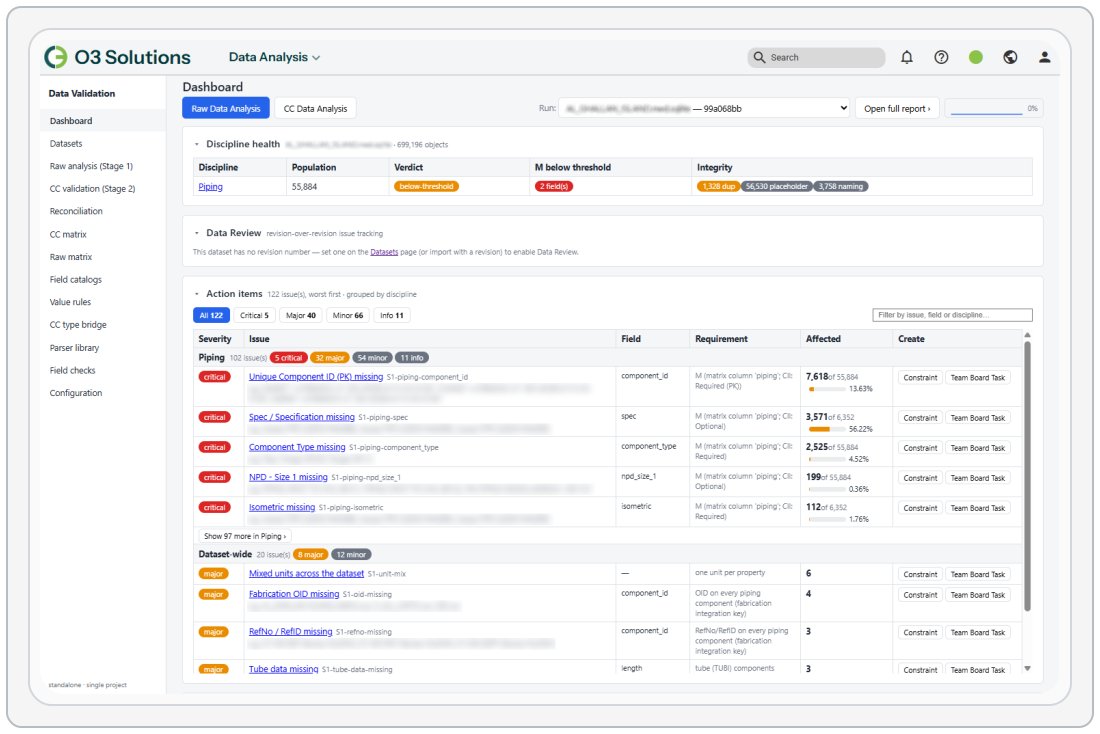
Two stages of validation, one before import and one inside O3, tell your team what is missing, why it matters and who owns the fix, with a raw-data analysis dashboard and tasks assigned directly from it.

O3 Prism action items grouped by severity
Data Review

A Refresh Your Team Can Afford to Run Every Day

When a new revision arrives, Data Review shows every add, delete and change in the context of the packages it affects. Planners accept, reject or quarantine changes row by row, preview the update in 3D before anything is overwritten, and O3 revalidates automatically with no new scripting. Because a refresh costs so little effort, the field works from current data.

O3 Prism data review comparing revisions
Enterprise Control

Independently Audited Security

O3 is ISO 27001 and ISO 27701 certified, and maintains SOC 2 Type II and SOC 3 reports. Each customer runs in its own single-tenant environment with enterprise-grade security.

Your team can audit the software that handles your data rather than depend on handoffs between people and outside parties. O3 does not use customer data to train AI models.

Request O3's security documentation at trust.o3.solutions.

ISO and SOC Certification
FAQs

O3 Prism FAQs

What is capital project data management, and how does O3 Prism handle it?
Capital project data management is the work of pulling models, drawings, takeoffs, bills of materials and documents together from many sources, checking them for completeness, and keeping them current as revisions arrive. O3 Prism automates that work, so analysts stop cleaning spreadsheets and writing a new script for every data set.
What is construction data validation, and how does O3 Prism do it?

Construction data validation means checking project data against a standard before anyone plans from it. O3 Prism checks your data against ISO 15926, CII definitions or your own standard, repairs unit mismatches and tag conflicts before import, then confirms that every component and work package has what its scope requires.

Can O3 Prism check BIM and 3D model data quality?

Yes. O3 reads native 3D model formats and fabrication files and flags missing data before anyone relies on it. Prism also covers drawings, takeoffs, bills of materials and documents, so the quality checks go beyond the model.

How is O3 Prism different from a common data environment?

A common data environment stores and shares project files, while O3 Prism works on the data inside them. O3 doesn’t host your files. It connects to the platform where they already live, such as SharePoint or a cloud folder, then validates the contents and keeps them current.

Does O3 Prism work with the systems we already use?
Yes. O3 pulls new data from SharePoint or a cloud folder on a schedule or through the API, and connects to other systems through out-of-the-box integrations or enterprise REST APIs. Your team keeps the tools it already uses.
We're really starting to focus on data as a deliverable, which is a complete paradigm shift, because now your measurements of success are going to be more data driven than output-driven on a PDF or a piece of paper.
Working with O3 on the Shell BlueCAT project has helped to streamline the RFI process and provide the project team with a central hub for data management. O3's ability to manage the data flow between multiple companies with a user-friendly interface has made the implementation easy for all of our staff.
We’ve found building multiple API integrations significantly reduces the manual effort necessary to aggregate constantly changing documents, material and schedule datasets, providing users with valuable insights on what is or may soon be constraining work.
More traditional thinking might suggest that data and processes need to be in a mature state prior to engaging or using a system or tool, however, O3’s flexibility and collaborative approach has enabled us to move forward along our continuous improvement journey together.
See O3 Prism in Action

See How O3 Prism Would Handle Your Project Data

When a new model revision lands, how long is it before your field team plans from it, and who does the work in between? In a demo, we'll walk through how O3 Prism takes in data from the places your team already uses, validates it against your standard and keeps every package current.

o3-prism-cta-field-coverage
rolling-out-a-field-app-crews-actually-use:-onfield
Rolling Out a Field App Crews Actually Use: ONField

awp-software-for-nuclear-epcs:-a-buyer’s-checklist
AWP Software for Nuclear EPCs: A Buyer’s Checklist
what-if?-test-scenarios-before-you-commit-the-iwp-sequence
What If? Test Scenarios Before You Commit the IWP Sequence