
Industry Trends
4 Best Practices for Project Portfolio Management in 2026

Digital transformation is exciting, but it can also feel overwhelming. Many organizations know they need better visibility, better coordination, and better automation. They simply do not know how to begin. That is exactly why O3 offers a structured pilot program that lets teams try the platform in a controlled, low risk environment before making a full commitment.
A pilot gives your team the chance to experience O3 with your own project data. This is very different from a generic demo environment. It allows your organization to validate workflows, test assumptions, and confirm that O3 aligns with the way you deliver projects. When teams see their data working inside the platform, confidence grows quickly. Stakeholders understand the value sooner, uncertainty decreases, and decision making becomes easier.
For many organizations, a pilot becomes the ideal bridge between curiosity and commitment. It works especially well when a team is exploring digital transformation but does not know where to start. If leaders need evidence of efficiency gains before approving a budget, a pilot can provide that proof. It also helps teams compare their current manual processes to O3 powered automation, which often reveals how much time and effort can be reclaimed. In many cases, end users want hands-on experience before a full rollout, and a pilot gives them exactly that.
One of the most important decisions is selecting which project to use. O3 generally recommends choosing a project that has already been executed. This ensures that the necessary data is available and ready for ingestion. It also allows teams to do meaningful before and after comparisons. By loading a completed project into O3, clients can immediately see how schedule reliability, workflow management, and overall visibility would have improved. The ideal project includes representative workflows, deliverables, and pain points so the pilot results accurately reflect day-to-day reality.
An O3 pilot is not simply a feature test, it’s an outcomes test. Before configuration begins, we host a structured workshop with your team to define success criteria. These are specific, measurable goals tied directly to business value. Examples include automating repetitive workflows, reducing administrative hours, solving challenges that existing tools cannot address, and improving transparency and communication. These criteria guide the entire pilot and become the benchmark for evaluation at the end.
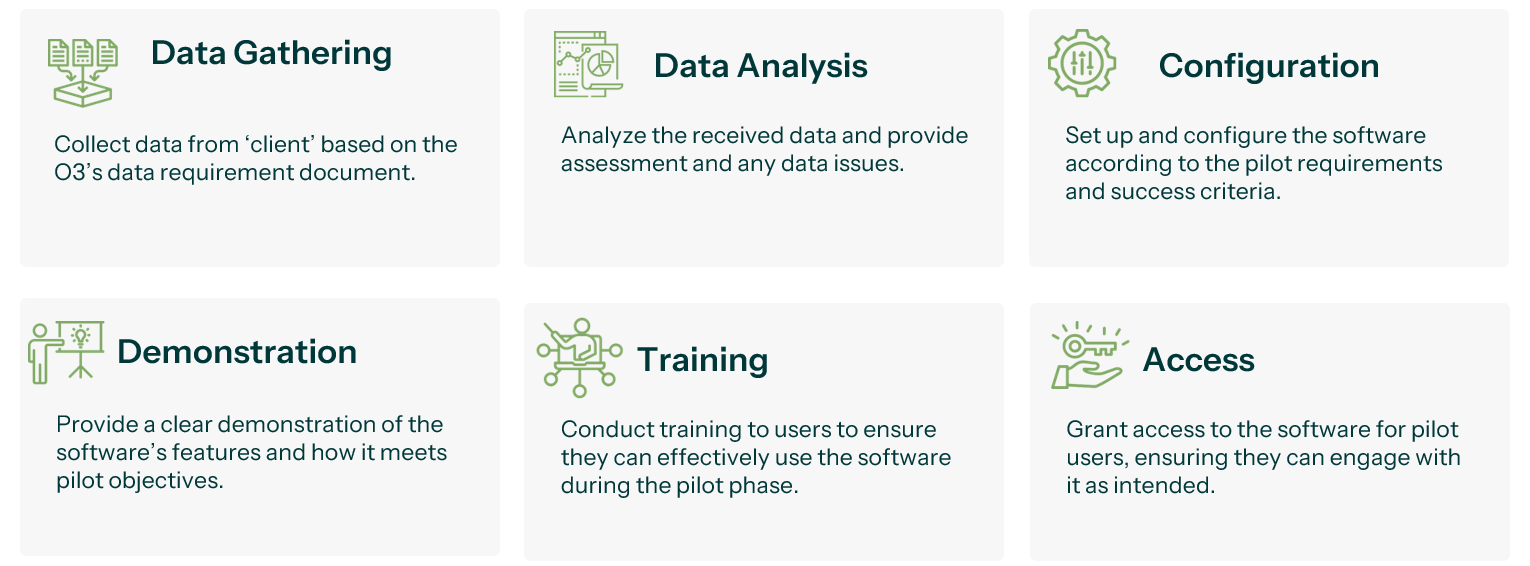
The full pilot lasts about three months and includes the following major milestones.
At the end of the pilot, we deliver a clear and structured assessment. This includes quantifying hours saved through automation, comparing new workflows to old manual processes, and evaluating how O3 would have improved the selected project. We capture user feedback and adoption trends, then tie all findings back to the success criteria that were defined at the start. This ensures the evaluation is grounded in real data and real outcomes.
When the pilot delivers the value you expect and you choose to move forward, O3 provides a smooth transition to our Client Success team. The work completed during the pilot does not get discarded. Instead, the configurations become part of your standard O3 project templates. This shortens the implementation timeline and eliminates the need to begin from scratch. New projects can be launched quickly and teams already understand how to use the system.
An O3 pilot is a low risk, high value approach to modernizing project delivery. By using real data, clear success metrics, and hands-on experience, organizations gain the confidence they need to adopt a platform that will change the way they plan and execute work. Pilots create fast wins, reduce uncertainty, and pave the way for enterprise scale transformation.
If your team is considering a smarter, more connected way to manage projects, a pilot may be the perfect way to start. Let us show you what your workflows could look like with O3. Reach out today to schedule your demo!
Experience how O3 can streamline your project management, reduce costs, and ensure on-time, on-budget delivery. Start your journey to smarter execution today.