
Industry Trends
4 Best Practices for Project Portfolio Management in 2026

The timing of AWP implementation determines whether a project captures its full value or settles for a fraction of it. When Advanced Work Packaging (AWP) starts during early planning, teams align engineering, procurement, and construction around a shared path forward, which reduces constraints, sharpens predictability, and protects margins. When AWP gets introduced late, often as a reaction to slipping schedules or budget overruns, the methodology still helps, but much of its potential has already been spent. The earlier AWP becomes part of the project DNA, the more leverage it provides. Capital projects that treat AWP as a foundational framework, rather than a corrective measure, consistently outperform those that bolt it on after problems surface. Timing, more than any single tool or technique, separates AWP success from AWP disappointment.
AWP should begin during front-end planning, ideally before front-end engineering design (FEED) is complete and well before detailed engineering hits full stride. The Construction Work Area (CWA) breakdown, Path of Construction (POC), and early Construction Work Package (CWP) definitions all need a seat at the table while major design decisions are still in motion. Starting AWP at this point allows construction logic to shape engineering deliverables and procurement strategies, rather than forcing construction to react to whatever the design team produces.
Most successful capital projects treat AWP as a planning discipline that runs alongside FEED and detailed engineering. Construction-driven sequencing informs how engineering packages are released, how vendors are evaluated, and how materials flow to the site. By the time construction mobilizes, the Installation Work Packages (IWPs) reflect a coherent execution strategy that the entire project team helped build.
Late AWP implementation produces diminishing returns because the most valuable decisions have already been made by the time the methodology arrives. Engineering deliverables have been sequenced without construction input. Procurement contracts have been awarded against schedules that may not match field reality. Subcontractor scopes have been written without consideration for how work will flow across areas.
When AWP gets introduced after these decisions are locked in, planners spend their energy reconciling misalignments instead of preventing them. The work packages still get built, but they often inherit constraints that could have been avoided. Crews wait for materials that arrived in the wrong order. Engineering revisions pile up because the original deliverable strategy did not account for how construction would actually progress. The project gains some structure, yet the savings AWP is known for, often cited as 10 percent or more on TIC, rarely materialize at that scale.

Early AWP planning gives engineering, procurement, and construction a common reference point. The Path of Construction defines how the asset will be built, and every upstream function organizes its work to support that sequence. Engineering Work Packages (EWPs) get released in an order that matches construction priorities. Procurement schedules align with installation windows. Vendor data, fabrication drawings, and material deliveries arrive when crews need them, not weeks before or after.
Alignment of this kind also changes how teams communicate. Engineers know which deliverables matter most to the field, and field leaders understand the engineering constraints behind each release. Procurement teams see the downstream consequences of delivery slips and can prioritize accordingly. Constraints get identified months before they would otherwise surface, giving the project room to resolve them without disrupting execution.
Introducing AWP after execution has begun creates a different kind of project. The methodology still helps planners organize the remaining work, but it operates inside a system that was not designed for it. Crews may already be working from drawings that were never sequenced against a Path of Construction. Materials may be staged in patterns that reflect procurement convenience rather than installation logic. Constraint management becomes a catch-up exercise, with planners working backward from field conditions to identify problems that should have been resolved during planning.
Teams in this situation can still recover meaningful value, particularly on the remaining scope, but the cost of retrofitting AWP into an active project is high. Workface planners spend time untangling existing commitments while trying to build forward-looking packages. The benefit case becomes harder to defend because the baseline has shifted.
The graph below shows the diminishing impact of AWP based on when you start it.
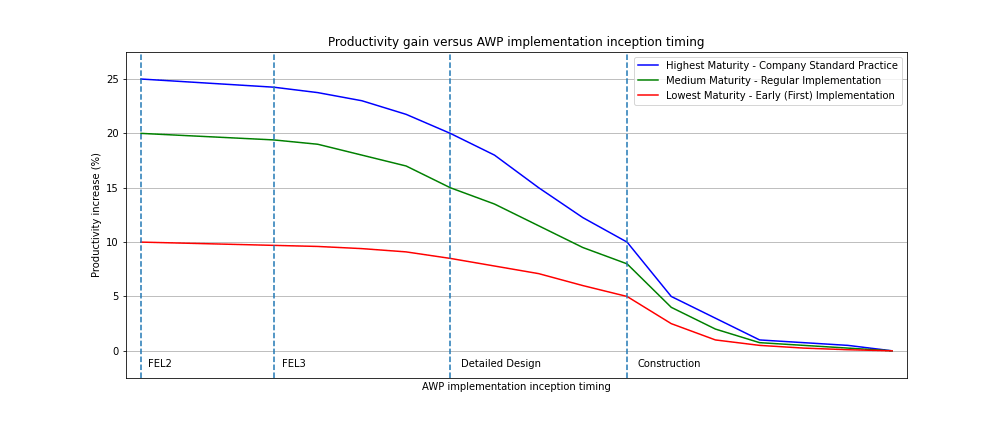
The three curves represent different levels of AWP maturity within an organization or project team. While maturity affects the overall productivity gain, every curve shows the same drop-off, which reinforces that timing matters regardless of how experienced the team is with AWP.
Successful AWP implementation follows a predictable rhythm across the project lifecycle. During front-end planning, the project establishes CWAs, develops the initial Path of Construction, and defines the AWP execution plan. As FEED progresses, CWPs take shape, and the engineering deliverables matrix gets aligned to construction priorities. Detailed engineering produces EWPs that map to CWPs, while procurement strategies are built around the same logic.
Workface planning ramps up as detailed engineering matures, with IWPs developed approximately 90 days ahead of installation. Constraint management runs continuously, identifying and clearing blockers before they reach the field. Once construction begins, the focus shifts to package release, progress tracking, and feedback loops that keep the plan synchronized with field execution. Each milestone builds on the last, and skipping any of them weakens the entire chain.
O3 supports AWP across every project phase, starting at the front end where the methodology delivers the most value. Early planning capabilities include digital whiteboarding, AI-powered sequencing, and progressive development from plot plan markups to full 4D visualization. As projects move into detailed engineering and workface planning, ONBuild takes over with graphical and non-graphical IWP scoping, robust constraint management, and a workface planning copilot that helps planners build better packages faster.
O3 connects engineering, procurement, and construction to the same model, the same schedule, and the same execution logic across every phase. Whether you are starting AWP on a new capital project or strengthening it on an active one, O3's team can help put the right structure in place.
Request a personalized demo today to see how O3 can support your next project.
Experience how O3 can streamline your project management, reduce costs, and ensure on-time, on-budget delivery. Start your journey to smarter execution today.